Home /FAQ
Concrete questions, answered directly.
Common questions about concrete installation, repair, and replacement in Lee's Summit and Kansas City. If your question isn't here, call us — we'll give you a straight answer.
Repair and Replacement
Do you repair concrete or replace it?
It depends on the condition of the slab and what caused the failure. Surface cracks, minor spalling, and isolated joint damage can often be addressed with repair or overlay products when the base is intact. Settled slabs, widespread cracking, drainage failures in the original installation, or slabs that have lost structural integrity usually call for full replacement. We assess both options during the site visit and give you a straight read on which one makes sense — including cases where repair is the right call.
How do you decide between repair and full replacement?
We look at four things: the structural condition of the slab itself, the subbase underneath it, the drainage situation, and what caused the problem in the first place. A slab with localized surface damage on a solid base is a repair candidate. A slab that's settled because the subgrade shifted, or one with widespread cracking from inadequate joint spacing, usually needs replacement with a corrected scope. We won't push replacement if repair is genuinely the right answer.
Is concrete resurfacing worth it?
Resurfacing and overlay products work well on slabs that are structurally sound with minimal surface wear or minor deterioration. They're not a fix for structural problems, settlement, or drainage issues — if those conditions exist, an overlay will fail the same way the original surface did. We'll tell you honestly whether your slab is a good candidate for overlay or whether the underlying issues make it a poor investment.
KC Soil and Conditions
Why does concrete crack in Kansas City?
Most concrete cracking in the KC area comes from two overlapping causes: clay soil movement and freeze-thaw stress. KC's clay-heavy soil expands when wet and shrinks when dry — that seasonal cycling creates stress on slabs from below. Winter freeze-thaw cycles add surface and edge stress on top of that. Concrete installed without adequate base preparation, proper joint spacing, or an air-entrained exterior mix typically shows problems within a few years. The failure almost always traces back to what happened before the pour, not the concrete itself.
What is air-entrained concrete and why does it matter in KC?
Air-entrained concrete has microscopic air bubbles mixed into the paste that provide relief space when water in the slab freezes and expands. For exterior concrete in Kansas City — driveways, sidewalks, patios, parking lots — air entrainment is important because of our freeze-thaw cycle frequency. Concrete that wasn't air-entrained for exterior conditions in this climate tends to scale and spall on the surface, sometimes within the first few winters. We specify air-entrained mixes for all exterior flatwork.
How does Lee's Summit clay soil affect concrete installation?
Lee's Summit sits on expansive clay that responds to moisture changes. In wet seasons, the soil swells; in dry periods, it shrinks. That movement applies pressure to slabs from underneath and can cause settlement when it's severe enough. We account for it with adequate subbase compaction, gravel base depth matched to the load and soil conditions, and drainage design that moves water away from the slab edge rather than letting it pool and permeate. Concrete poured directly on improperly prepared clay will shift — it's not a matter of if, but when.
Installation and Timeline
How soon can I drive on a new concrete driveway?
Light passenger vehicles can typically drive on new concrete after 7 days. Foot traffic is usually fine after 24-48 hours. We recommend waiting the full 28-day cure period before parking heavy vehicles, placing significant static loads, or doing anything that puts concentrated stress on the slab. Actual cure time varies with temperature and weather conditions — we'll give you specific guidance based on the pour conditions at your project.
How long does concrete driveway installation take?
Most residential driveway replacements take two to three days of active work — demolition and subbase prep on the first day, forming and pour on the second, with finishing and initial curing completing that day or the next. Larger driveways, unusual drainage work, or difficult subbase conditions can extend the schedule. We'll give you a realistic timeline during the estimate visit based on your specific scope.
What time of year is best for concrete work in Kansas City?
The practical window for exterior concrete in KC runs from roughly April through October, with the sweet spot being late spring and early fall when temperatures are moderate and stable. Concrete can be poured in cold weather with the right precautions — blankets, accelerators, and cold-weather mix design — but it adds complexity and cost. Summer pours in extreme heat also require adjustments to mix timing and curing. We work year-round and will tell you upfront if conditions on a particular week are right or not for your pour.
Stamped and Decorative Concrete
When does stamped concrete make sense?
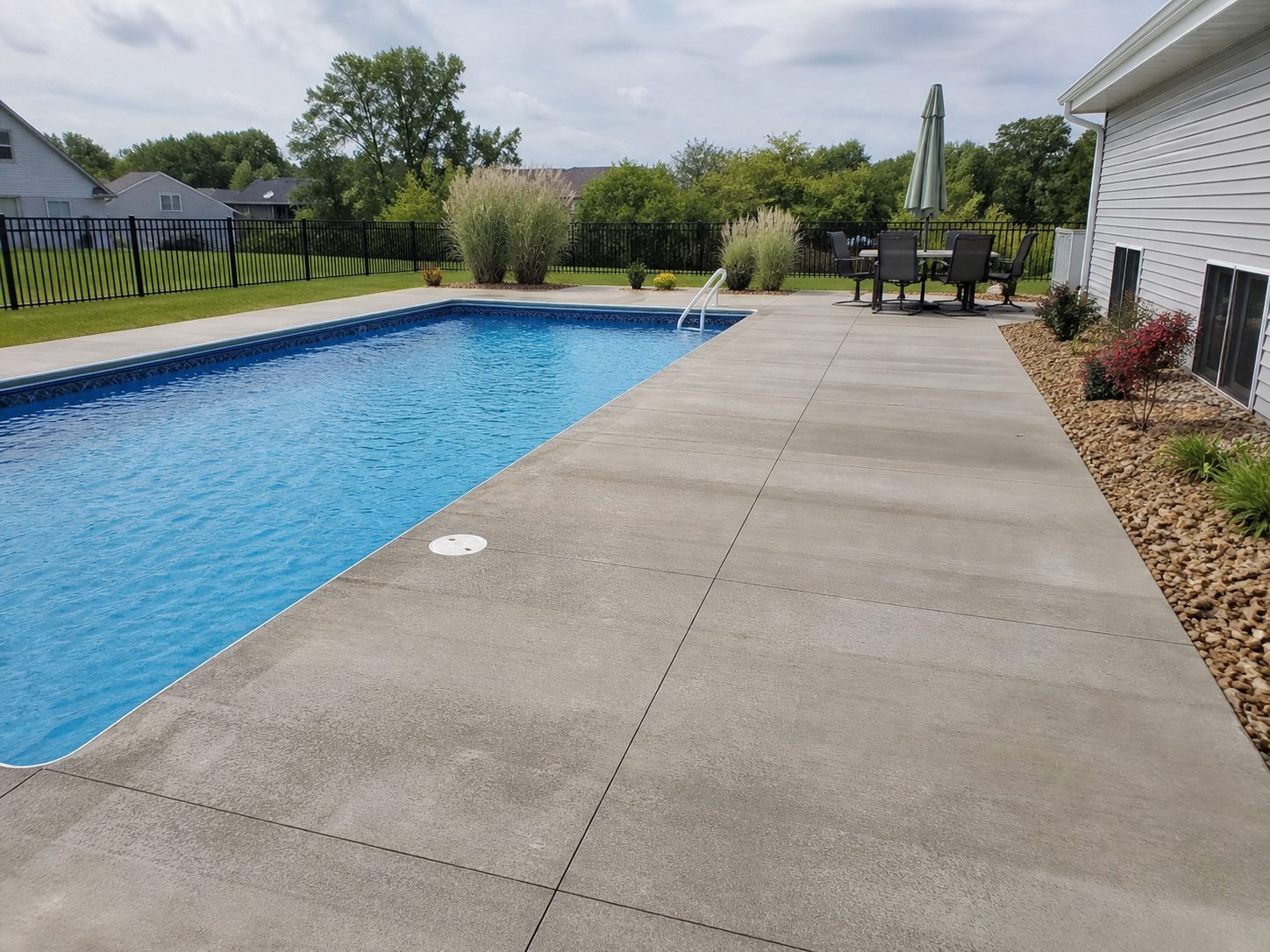
Stamped concrete works well for patios, pool decks, entries, and feature areas where you want a textured or patterned finish without the maintenance complexity of pavers or natural stone. It requires a solid base and careful finishing conditions — humidity, temperature, and crew timing all matter for decorative work. We'll tell you if the site conditions and season are right for a stamped pour or if a different schedule would give you better results.
How does stamped concrete hold up in KC winters?
Stamped concrete holds up well in KC winters when it's installed with the right mix design and base prep. Air entrainment is especially important for stamped exterior concrete because the textured surface has more exposure area than smooth flatwork. The main failure mode we see on older stamped concrete is surface delamination or color fading from deicer damage — both of which are largely preventable with the right mix spec and by avoiding rock salt on stamped surfaces. We use concrete sealers on stamped work and recommend re-sealing periodically.
Commercial Concrete
Do you install commercial concrete?
Yes. We handle commercial concrete for foundations, sitework, parking lots, warehouse and industrial floors, ADA ramps and accessible entries, curbs, and gutters. We work with commercial property owners, developers, and general contractors in Lee's Summit and throughout the KC metro. Commercial scopes have different load requirements, mix specifications, and scheduling constraints than residential — we work to those specs.
Can you handle large commercial pours?
Yes, for the types of commercial work we do — parking lots, warehouse floors, foundations, and sitework. We're not a high-rise or large infrastructure contractor. If the scope is beyond what we're set up for, we'll tell you during the estimate conversation rather than after you've committed.
Estimates and Process
How does your estimate process work?
We come to the site before putting any numbers together. Most concrete scopes — driveway replacement, commercial flatwork, repair assessment — require seeing the conditions in person. We'll schedule a visit, look at the subgrade, drainage, access, and scope, and put together a written estimate with clear pricing. You won't receive a phone quote for work that needs a site look.
Are your estimates actually free?
Yes. Site visit and written estimate are no cost. If we can give you a useful answer over the phone, we will — but for most projects, the honest answer is that we need to see it first.
Do you serve areas outside of Lee's Summit?
Yes. Lee's Summit and Jackson County are our primary area. We also serve Kansas City, Independence, Blue Springs, Grain Valley, Raymore, Belton, Grandview, Pleasant Hill, Harrisonville, Oak Grove, and Odessa. Call us to confirm your location if you're on the edge of our coverage area.
Still Have Questions?
Call us. We'll give you a direct answer.
If your situation is specific or you want to talk through the scope before requesting an estimate, a phone call is the fastest path.